yesterday

Members of the deaf community have created a ‘virtual sign language’ specifically for accessing VR technology, research on inclusivity in gaming has shown.
A PhD student from the University of the West of Scotland, Lara McIntyre, has led a study on the experiences of deaf people in VR social spaces as part of her postgraduate degree.
The findings, shared ahead of British Sign Language (BSL) awareness day [28 April], highlight VR headsets’ ‘incompatibility’ with BSL - a visual-spatial language used by 87,000 deaf people in the UK, which uses a mix of hand shapes, facial expressions, lip patterns and body language to convey meaning.
It shows some deaf people who actively use VR as a means of socialising with other gamers are adapting by creating a new form of sign language, called virtual reality sign language (VRSL), to access the technology under its current constraints.
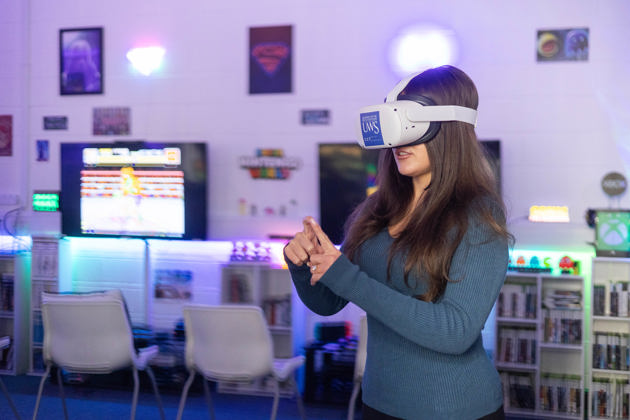
VR is a popular medium for connecting with people across the world, using custom avatars to visit digital coffee shops to virtual concerts. Around 3.2 million people in the UK own a headset, which allow users to immerse in 3D, artificial worlds as if they were physically present, by tracking head and sometimes body movements.
Lara said: “VR headsets can’t capture the full spectrum of BSL communication, such as facial expressions, body language, and lip patterns. Some devices feature audio instruction with no subtitles, while over reliance on written English can feel foreign to some deaf users, due to vocabulary and grammar structures which lack sign language equivalents.
“As a result, VRSL is being used by some deaf gamers - derived from traditional sign language and simplified to core gestures. However, this strips back and dilutes communication, requires new learning and can vary itself depending on the individual capabilities of different devices.
“These barriers may prevent members of the deaf community, particularly younger generations, from accessing a space which could otherwise provide an opportunity for social connection.”
Around 18 million adults in the UK are living with some form of hearing loss, while approximately 900,000 people are severely or profoundly deaf, according to latest figures from the Royal National Institute for Deaf People.
Paisley student Lara, who is a CODA - the acronym for child of deaf adult(s) - helps interpret for her mum and says she has witnessed first-hand the challenges that deaf people can face living in a predominantly hearing society.
Lara said: “My mum was born profoundly deaf, so her first language is sign language. That can make navigating everyday life - where very little people use your native language - tricky.
“Shopping for groceries has its hurdles. And something that I might take for granted, like bumping into a friend and having an impromptu catch up, isn’t as easy for her. Social isolation can easily creep in.”
Throughout her time at University, Lara has explored ways in which games development can incorporate different communication needs and educate hearing communities, designing a mobile application as part of her honours degree which gamifies the education of the BSL alphabet.
Now, Lara hopes her PhD research will raise awareness and encourage change within the sector. She hopes to create a VR application with deaf communication at its centre, where deaf people can access a virtual social space with sign language as the main means of communication.
Lara also wants to see more VR spaces which bring gamers together, with potential for features like sign-to-speech and speech-to-sign translation systems, where hearing individuals can use their sign language learning in real time and apply it directly when interacting with deaf people.
“Part of the solution to making VR technology more inclusive is having a deaf person in the room when it’s being developed. There are so many opportunities for VR to embrace, like avatars which use sign language or games which help people learn. Awareness, education and representation can help promote connection and bridge the gap between the deaf and hearing communities.”
Lara McIntyre, PhD student, University of the West of Scotland
Professor Robert MacIntosh, Interim Deputy Vice-Chancellor and Pro-Vice-Chancellor (Research and Innovation) at the University of the West of Scotland, said: “The ability to communicate is such an important enabler of participation in every setting. Lara’s groundbreaking work shows how languages evolve and adapt in response to new technologies. At UWS, we are proud to see our students doing research which has global societal impact, and which lives up to our commitment to promote social inclusion.”
The work directly addresses the United Nations Sustainable Development Goals, particularly Goal 4, Quality Education, and Goal 10, Reduced Inequalities.