About the Research Excellence Framework
The Research Excellence Framework (REF) is the UK’s system for assessing the excellence of research in higher education institutions.
The main purpose of REF is to assess the quality of UK research and inform the selective allocation of core research funding grants to universities by the four UK higher education funding bodies: the Department for Economy, Northern Ireland (DfE), the Higher Education Funding Council for Wales (HEFCW), Research England and the Scottish Funding Council (SFC).
REF feeds directly into our strategy and vision for the future of research at UWS. It provides a great opportunity for reflection and review, in line with our mission and values set out in Strategy 2030 to support excellent, relevant, and purposeful research, aligned with the United Nations Sustainable Development Goals.
We are now preparing for REF 2029, which will be submitted in Autumn 2027. The results of REF 2021 were announced publicly on 12 May 2022 and can be found below.
For any queries about REF preparations at UWS, please contact UWSREF2029@uws.ac.uk. UWS staff can find additional information on the Research Services UWS Connect pages.
REF 2029
The current REF assessment period runs from 1 January 2021 to 31 December 2027. Full guidance for the REF 2029 assessment can be found on the REF 2029 website.
REF 2029 will have three elements, assessed by disciplinary panels divided into ‘Units of Assessment’:
- Contribution to Knowledge and Understanding (previously ‘Outputs’ in REF 2021) will constitute 55% of each unit’s overall profile and will be assessed through research outputs.
- Engagement and Impact (previously ‘Impact’ in REF 2021) will constitute 25% of each unit’s overall profile and will be assessed through impact case studies.
- Strategy, People and Research Environment (previously ‘Environment’ in REF 2021) will constitute 20% of each unit’s overall profile and will be assessed through an institution-level statement and a unit-level statement.

Our approach to REF
As a member of the Coalition for Advancing Research Assessment (CoARA) and a signatory of the San Francisco Declaration on Research Assessment (DORA), we believe in responsible and fair research assessments that are based on qualitative evaluation and recognise the diverse outputs, practices, and activities that maximise the quality and impact of research. You can read UWS’s CoARA Action Plan to see how we are acting on these commitments.
UWS is committed to ensuring that its participation in the Research Excellence Framework (REF) 2029 is underpinned by principles of fairness, transparency, and inclusivity. Our REF 2029 Code of Practice sets out the institutional approach to key decisions for REF 2029. It serves not only as a procedural guide but also as a framework for embedding equity and consistency across all REF-related activities. By adopting this Code of Practice, UWS affirms its commitment to supporting a diverse research community and maintaining confidence in the integrity of its submission.
The UWS REF 2029 Code of Practice was approved by the funding panels that manage REF 2029 in July 2026. It covers:
- Institutional arrangements for UWS REF 2029 strategy and governance.
- How the University has identified staff with significant responsibility for research and staff with research independence in the HESA submission to inform our volume measure.
- How staff volume will be allocated to Units of Assessment in the HESA submission.
- How the University has selected research outputs to be submitted, ensuring a fair and transparent approach.
- Equality Impact Assessments for all procedures detailed in the Code of Practice, including arrangements for monitoring and review of any emerging equality impacts.
Our REF 2021 Results
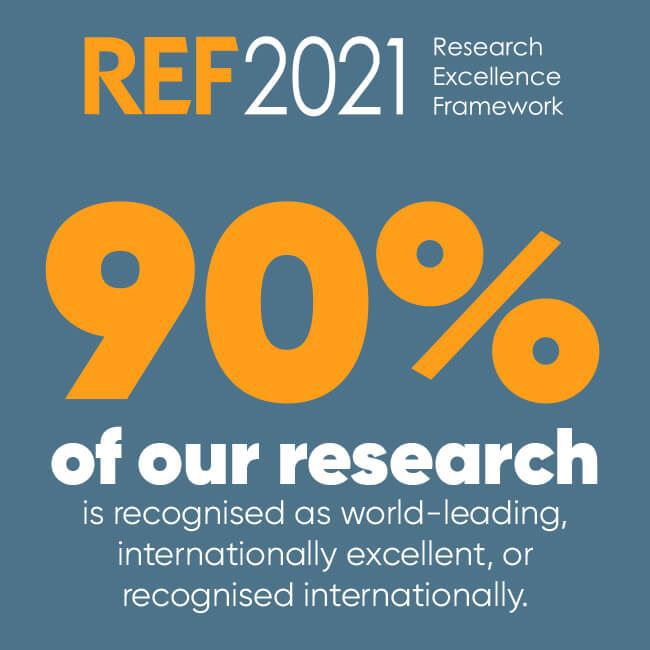
Ninety percent of our research was world-leading, internationally excellent or recognised internationally.
The University also increased its position for research intensity, now ranking within the top 90 universities in the UK.
UWS’s REF results include an outstanding performance for Sport and Exercise Sciences, Leisure and Tourism, ranking within the top three Scottish universities in this area, with 71 percent of research recognised as world-leading or internationally excellent.
The University also saw 100 percent of its impact in Physics recognised as internationally excellent.
The results reinforce the position that UWS makes a significant contribution to economic, social, cultural, health and public policy, both internationally and within our local communities.
Last updated: 09/07/2026