Music Technology
Award
BSc (Hons)
Duration & study mode
4 years full-time, typically 6 years part-time
Location
Paisley
Additional information
Ucas code
W350
Course starting dates
-
Paisley: September
Last updated: 18/08/2026
Register for one of our undergraduate Open Days and find your place. Events hosted across our 4 Scottish campuses throughout October and November.
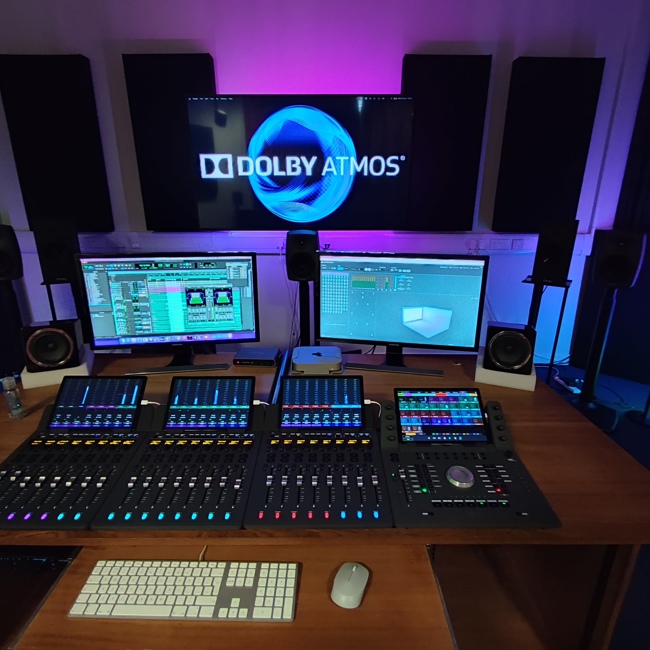
The BSc Music Technology provides students with the knowledge and practical experience to work in a range of areas within the creative music, audio and media sectors.
Guest speakers from industry also form part of the course to further deepen your understanding of the subject.
The Paisley Campus facilities include three professional industry-standard recording and production studios, two specialist iMac audio labs.
We offer areas of study that focus on developing high-calibre graduates ready for a successful career in the music and media industry.
This course is accredited by JAMES (Joint Audio Media Education Support) and is an Avid Learning Partner.
Throughout this course you will be provided with the knowledge and practical experience needed to work in the creative music, audio and media sectors. You’ll develop a wide range of industry-relevant technical skills related to music and audio production.
Teaching is delivered between two dedicated Apple Mac labs complete with two recording studios and two surround post-production suites, one of which is Dolby Atmos enabled. The studios operate with Pro Tools and Logic with a selection of outboard processing hardware catering for up to 24 channels of through an Audient ASP8024 Heritage console.
You’ll also have access to industry standard software and hardware. Our Macs are equipped with the latest versions of Avid Pro Tools, Ableton Live, Apple Logic Pro X, Final Cut X and Max for Live.
Recent industry guest speakers include Derek Richards FSRA; Andrew Britton of BBC Scotland; Alan McEwan, Studio Manager Brick Lane Studios; and Ross Cooney of Street Jazz Music Group.
National Student Survey 2026
Our Programme Leaders have recorded videos to help you discover all there is to know about our courses. From professional accreditation to programme modules and career opportunities, our Programme Leaders will help answer all your questions. You can view the video for this course by clicking the link below.

This course features an optional placement module in Year 3, which may be with a Scottish or other UK music industry company.
Broaden your horizons, learn a new language and prepare for the best international opportunities available with study abroad at UWS.
Music Technology graduates have the technical skills, business awareness and networking abilities to secure roles in industries including: audio post-production; acoustics and live sound; broadcast audio; education; immersive game audio; music mixing & mastering; sound design; and video and media production.
Graduates from this degree will be able to apply for master's degrees in music technology, audio technology and sound production.
The BSc Music Technology will teach you to produce and process music and audio ready for distribution for applications including web and multimedia, film, animation, and computer games. You will also be involved in studio recording and production, location recording and audio post-production, electronic music composition and sound design.
Computing at UWS
UWS has been delivering career-focused computing degree courses for nearly 50 years. Computing courses at UWS are designed in collaboration with leading companies to produce work-ready graduates with the skills that industry needs.
We work with major industry leaders to give our students work-based learning opportunities to put their knowledge into practice. Our students graduate ready for career success in this fast-changing, dynamic industry.
Students will be introduced to modern audio/music recording and production techniques through creating podcasts and music recording projects in the studio with a range of software and AVID Pro Tools systems. Creativity within computer-based music will be studied and developed. Within live sound and acoustics, they will work with analogue and digital consoles and small PA systems. They will also investigate and develop an appreciation of the scope of music production and the music and media industry.
Studio recording and production techniques are further developed with a deeper focus on industry technical standards. You will study electronic music and understand MIDI control through composition and sound design in Ableton. Audio post production work enhances your skills in synchronisation, editing and processing techniques for deliverable media. Practical impulse response capture and room acoustics theory provides you with contextualised learning in reverberation, room design and acoustic analysis. Continuing studies in sound reinforcement theory and systems will culminate with group work and the technical production of a live music event.
You will work in small production teams with musicians and artists producing professional multi-song recordings (EP's), video and web content for promotional purposes for the artist. This will be used to showcase your employable skills within a portfolio context. Music and media industry business and legal aspects are studied in terms of employment and entrepreneurship. Audio processing is introduced through the creation of a suite of effects developed in Max For Live for Ableton Live. You will have an opportunity to participate in a music industry placement in the UK or abroad in a partner institution, such as the Harris Institute in Canada.
The honours year features an extensive individual project culminating in the production of a dissertation and portfolio assets. You can customise your topic to enable you to develop specialised knowledge and skills towards your area of interest for future employment.
You will be required to raise the quality of your work to implement professional and European standards for the delivery of audio in stereo and surround formats.
Using current industry relevant mastering plug-in software and applying your professional listening skills, you will finalise selected tracks and format them for distribution. You will produce and synchronise all the audio assets required to complete a sound track for an animated short film.
You will apply the principles of signal processing in the development of software synthesisers and generative MIDI sequencing devices using Max For Live in Ableton Live.
You will further develop your sound design and audio post-production skills within a non-linear audio environment for the specific requirements of computer games.
You will be taught through a combination of lectures, tutorials and production workshops.
Programme Specification and Module Descriptors for Undergraduate and Postgraduate courses are available to download (PDFs). These provide you with core information concerning your chosen subject.
As part of your studies, you also have the opportunity of taking language modules each year, which can count towards your degree. Choose modules from French, Spanish or even British Sign Language (BSL) from absolute beginner to near-native speaker level. Go on! Broaden your horizons, learn a new language, enhance your international perspective and your CV.
Why not add language modules in BSL, French or Spanish to your studies which can count towards your degree or as extra modules? Go on! Broaden your horizons, extend your international perspective and enhance your CV.
Study Modern LanguagesJoin a community and dynamic culture that’s all about creativity, inclusion, connection, skills development and careers.
Making new friends is one of the best parts of university life and you’ll find plenty of opportunities to connect with others and enjoy an exciting social life through events, clubs and shared interests.
Proud to be The Times and The Sunday Times Scottish University of the Year for Social Inclusion 2026. UWS is a leading institution for widening participation in higher education, committed to driving social inclusion and reducing inequalities.
Our Undergraduate events are perfect chance to get to know more about the student experience and what it is like to study at UWS.
We host a range of events throughout the year, both on campus and online.
This programme is in Clearing for students resident in Scotland, Rest of the UK, Republic of Ireland, and EU. During Clearing our entry requirements remain flexible, and we are committed to providing opportunities to study with us based on a range of qualifications. Please get in touch, and we can discuss your specific circumstances. You can apply now through UCAS or find out more information about the Clearing process on our dedicated Clearing hub
We understand that results don’t always go to plan, so our entry requirements during Clearing are flexible. We accept a wide range of qualifications and typically use the UCAS Tariff and the SCQF tariff as a guide, while also taking a holistic approach to each application. This means we’ll consider your overall academic profile and individual circumstances when making decisions.
If you’re close to meeting the entry requirements for your offer or planning to apply through Clearing and looking to top up your qualifications, our Summer School could help you secure your place this September.
If you’re interested, we encourage you to get in touch with our team to discuss your options—we’re here to help.
Visit our dedicated Clearing hub to find out more about the process and next steps.
We welcome Scottish, UK and international students and consider all applicants on an individual basis.
All academic degrees/awards at UWS are taught in English. For applicants whose first language is not English*, the University sets a minimum English language proficiency level. All English language qualifications must have been gained within two years of the start of your UWS course.
* applicants who are exempt from English language requirements include:
In general terms, if you are applying to study a course at, or above, Year 1 (SCQF Level 7) bachelor’s degree level, then the UKVI’s minimum level of English proficiency is Common European Framework for References of Languages (CEFR) at B2 (Upper Intermediate).
At UWS, we define our general English language requirements using the International English Language Testing System (IELTS) Academic module (not General Training) as follows:
These are minimum requirements and some courses may require a higher standard for admission†.
† Exceptions to this level of IELTS scoring exist for some accredited or professionally-recognised courses (see IELTS Score Exceptions section below for more information).
For our research degrees (MRes, MPhil, PhD, DBA, DProf) applicants are required to have an IELTS score as follows:
For Midwifery courses that lead to professional registration with the Nursing & Midwifery Council (BSc Midwifery), applicants are required to have an IELTS score as follows:
Our BSc Paramedic Science degree leads to professional registration with the Health and Care Professions Council (HCPC); it has different IELTS requirements than other Health-related courses. Although it is not possible to apply for this degree directly as an international student, for applicants who meet SAAS residency requirements and for whom English is not their first language, then the following IELTS scores are required:
For our BSc (Hons) Biomedical Science and MSc Advanced Biomedical Science degrees, which may lead to professional registration with the Health and Care Professions Council (HCPC), applicants are required to have an IELTS score as follows:
Our BA (Hons) Social Work and MSc Social Work degrees are professionally recognised by the Scottish Social Services Council and applicants are required to have an IELTS score as follows:
For our Certificate of Higher Education courses, applicants are required to have an IELTS score as follows:
In additional to IELTS, we also accept a number of alternative English language for application and admission to our courses for both home/EU and international students at bachelor's degree study at Year 3 (SCQF Level 9), and above. From Cambridge to TOFEL iBT qualifications the number of these qualifications is extensive.
Find out about non-IELTS English Language Tests
UWS has also reviewed a range of High / Secondary School qualifications studied by non-EU applicants that can be used as a basis of entry to a UWS. These range from Botswana GCSEs to USA High School Graduation Diplomas, the number of these qualifications is extensive.
Find out more about international English Language high-hchool qualifications
Applicants who do not meet the minimum English language requirements have the option to study one of our preparatory and pre-sessional English courses. UWS courses available are:
£1,820 per year of study (usually paid by the Scottish Government via SAAS*)
£9,535 per year of study (4 years of study for the price of 3 years)
£9,535 per year of study (4 years of study for the price of 3 years)
£18,000 per year of study
£305 per module (20 credits)
£1,590 per module (20 credits)
£1,590 per module (20 credits)
£3,000 per module (20 credits)
£1,820 per year of study (usually paid by the Scottish Government via SAAS*)
£9,790 per year of study (4 years of study for the price of 3 years)
£9,790 per year of study (4 years of study for the price of 3 years)
£18,900 per year of study
£305 per module (20 credits)
£1,630 per module (20 credits)
£1,630 per module (20 credits)
£3,150 per module (20 credits)
Estimated cost per year of study.
Ready to apply? All UK & EU Undergraduate applications should be made through UCAS. Further information for international, part-time and exchange applications can be found below.
Apply on UCASAll UK and EU applicants for undergraduate study, not applying through an agent or partner, should apply through UCAS (Universities and Colleges Admissions Service).
Please refer to our Undergraduate Application Guide for domestic & EU/EEA to find more information on when and how to apply to study at UWS. You can find out more about applying for this undergraduate course on UCAS.
Students from non-EU/non-EEA countries can apply directly to UWS via our dedicated online application system. The latest we can process your application is 6 weeks before the course start date to allow for visa processing times. For more information on when and how to apply to study at UWS please refer to our International Undergraduate Application Guide.
For part-time & online study, you should apply directly to the University through our online application system, not through UCAS. Please select the part-time mode of study when submitting your application. Before you begin your application, it is important to read the part-time application step-by-step guide for a smooth process.
To come to UWS as a visiting student on a study abroad or exchange programme, you must apply entirely through our online system.
An ATAS certificate is not required for overseas students applying for this course.
UK students
Our enquiry team is here to help: ask@uws.ac.uk
International students
Contact our dedicated international team: international@uws.ac.uk
We will always try to make sure that we publish accurate course information but we do not accept responsibility for any mistakes or omissions. We will also try to make sure that we deliver our courses in line with our published information. However, we may not always be able to do so and you can find further information about this in our enrolment terms and conditions.