Neurodiversity
Award
MSc
Duration & study mode
Typically 3 years part time
Location
Fully online
Course starting dates
-
Fully online: January 2026
Last updated: 03/02/2026
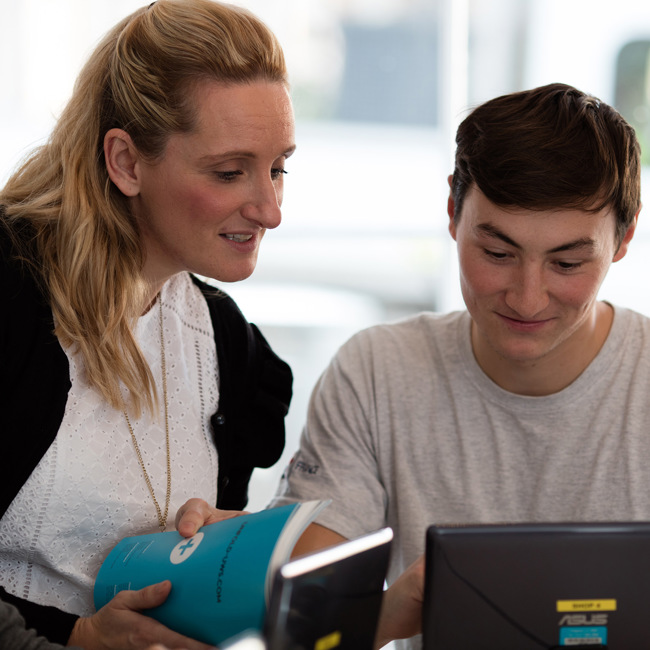
The MSc Neurodiversity is a fully online postgraduate degree designed for professionals across all professional walks of life including, health, social care and education.
Grounded in the neurodiversity paradigm, it challenges deficit-based models and promotes strengths-based, inclusive approaches to supporting neurodivergent individuals throughout the lifespan. Delivered flexibly over three years, the programme combines interactive online learning, live sessions, and practice-based tasks, making it ideal for working professionals.
Throughout your studies, you will develop advanced knowledge and leadership skills to drive systemic change, co-design inclusive solutions, and advocate for neuro-affirming practices. With exit points at PgCert and PgDip levels, the MSc offers a clear progression route and enhances employability across diverse fields, including policy, integrated care, and third-sector organisations.
As a graduate of the MSc Neurodiversity, you will be equipped to influence practice, shape inclusive services, and contribute to research, ensuring meaningful impact in a rapidly evolving area of professional need.

The programme is designed for working professionals, and is delivered fully online with flexibility to fit around other commitments. There is a mix of live interactive sessions and study that can be completed in your own time. delivered over three years with asynchronous learning and live interactive sessions.

It is envisioned that graduates of this programme may work in the following sectors:
We welcome Scottish, UK and international students and consider all applicants on an individual basis.
Do not worry if your qualifications are not listed here, we take a range of factors into account when assessing your application and are happy to consider other alternative combinations of qualifications and experience
If you are applying with an EU or non-EU qualification, please check our Postgraduate Entry Requirements page, which gives more information about country-specific entry requirements.
All academic degrees/awards at UWS are taught in English. For applicants whose first language is not English*, the University sets a minimum English language proficiency level. All English language qualifications must have been gained within two years of the start of your UWS course.
* applicants who are exempt from English language requirements include:
In general terms, if you are applying to study a course at, or above, Year 1 (SCQF Level 7) bachelor’s degree level, then the UKVI’s minimum level of English proficiency is Common European Framework for References of Languages (CEFR) at B2 (Upper Intermediate).
At UWS, we define our general English language requirements using the International English Language Testing System (IELTS) Academic module (not General Training) as follows:
These are minimum requirements and some courses may require a higher standard for admission†.
† Exceptions to this level of IELTS scoring exist for some accredited or professionally-recognised courses (see IELTS Score Exceptions section below for more information).
For our research degrees (MRes, MPhil, PhD, DBA, DProf) applicants are required to have an IELTS score as follows:
For Midwifery courses that lead to professional registration with the Nursing & Midwifery Council (BSc Midwifery), applicants are required to have an IELTS score as follows:
Our BSc Paramedic Science degree leads to professional registration with the Health and Care Professions Council (HCPC); it has different IELTS requirements than other Health-related courses. Although it is not possible to apply for this degree directly as an international student, for applicants who meet SAAS residency requirements and for whom English is not their first language, then the following IELTS scores are required:
For our BSc (Hons) Biomedical Science and MSc Advanced Biomedical Science degrees, which may lead to professional registration with the Health and Care Professions Council (HCPC), applicants are required to have an IELTS score as follows:
Our BA (Hons) Social Work and MSc Social Work degrees are professionally recognised by the Scottish Social Services Council and applicants are required to have an IELTS score as follows:
For our Certificate of Higher Education courses, applicants are required to have an IELTS score as follows:
In additional to IELTS, we also accept a number of alternative English language for application and admission to our courses for both home/EU and international students at bachelor's degree study at Year 3 (SCQF Level 9), and above. From Cambridge to TOFEL iBT qualifications the number of these qualifications is extensive.
Find out about non-IELTS English Language Tests
UWS has also reviewed a range of High / Secondary School qualifications studied by non-EU applicants that can be used as a basis of entry to a UWS. These range from Botswana GCSEs to USA High School Graduation Diplomas, the number of these qualifications is extensive.
Find out more about international English Language high-hchool qualifications
Applicants who do not meet the minimum English language requirements have the option to study one of our preparatory and pre-sessional English courses. UWS courses available are:
Our course has various exit points allowing you to exit with a Postgraduate Certificate (PgCert), Postgraduate Diploma (PgDip) or Master's award depending on your needs. However, most students will typically complete the full Master's award (180 credits).
As this programme is delivered fully online, the UWS Virtual Learning Environment will be used alongside MS TEAMS for scheduled online teaching sessions.
Introduction to Neurodiversity (20 credits) Core
Neuro-Inclusive Communication (20 credits) Core
Neurodiversity, Culture & Families (20 credits) Core
Neurodiversity & Technology (20 credits) Core
Neurodiversity & Technology (20 credits) Core
Neurodiversity & Health (20 credits) Option
Neurodiversity & Lifelong Learning (20 credits) Option
Neurodiversity & Health (20 credits) Option
Neurodiversity & Lifelong Learning (20 credits) Option
For the award of a PG Cert Neurodiversity, at least 60 Credit points must be achieved from the modules specified above. Neurodiversity & Lifelong Learning or Neurodiversity in Health can be included, but not both.
Introduction to Neurodiversity (20 credits) Core
Neuro-Inclusive Communication (20 credits) Core
Neurodiversity, Culture & Families (20 credits) Core
Research for Health & Social Care (20 credits) Core
Neurodiversity & Technology (20 credits) Core
Neurodiversity & Health (20 credits) Option
Neurodiversity & Lifelong Learning (20 credits) Option
For the award of a PG Dip Neurodiversity, at least 120 Credit points must be achieved and include the core modules specified above.
Introduction to Neurodiversity (20 credits) Core
Neuro-Inclusive Communication (20 credits) Core
Neurodiversity, Culture & Families (20 credits) Core
Research for Health & Social Care (20 credits) Core
Neurodiversity & Technology (20 credits) Core
Master’s Research Project (60 credits) Core
Neurodiversity & Health (20 credits) Option
Neurodiversity & Lifelong Learning (20 credits) Option
For the award of an MSc Neurodiversity, at least 180 Credit points must be achieved and include the core modules specified above.
Scheduled Learning: 43%
Independent Study: 57%
Assessment:
Coursework: 100%
Coursework will include: essays, reflective pieces of work, a dissertation project, posters and presentations. There will also be multiple choice tests in some modules.
Our assessment strategy ensures there are multiple points to access formative and summative feedback to enable you to feed-forward to improve your academic skills as the module and course progresses.
All students should apply directly to the University through our online application system. Before you apply, you should check that you meet our entry requirements and you should have all your supporting documents ready.
The first stage of the process is to complete the initial application form. You will then receive a follow-up email with further instructions relating to your application including documents that you will need to forward to support your application, e.g. degree transcripts and certificates etc.
Most courses don't have a formal closing date, but they will close when they are full; apply early to avoid disappointment. There may also be funding deadlines that apply to you.
The Academic Technology Approval Scheme (ATAS) applies to all international students and researchers (apart from exempt nationalities) who are subject to UK immigration control and are intending to study or research at postgraduate level in certain sensitive subjects.
Students and researchers who are nationals of EU countries, the European Economic Area (EEA), Australia, Canada, Japan, New Zealand, Singapore, South Korea, Switzerland or the United States of America do not need an ATAS certificate.
An ATAS certificate may be required for certain taught postgraduate master's degrees for international students at UWS.
For the latest information on ATAS and details of eligibility and how to apply for a certificate check the UK Government's dedicated ATAS web pages.
Do you have a question about applying for this course? Our friendly admissions teams are here to help!
International prospective students
Our international team is ready to support you with your application and any questions about joining UWS from abroad.
UK-based prospective students
If you’re applying from within the UK, our applicant enquiry team is here to guide you every step of the way.
£7,500 Total cost for online study
£11,750 Total cost for online study
£11,750 Total cost for online study
£18,000 Total cost for online study
£1,070 per module (20 credits)
£1,680 per module (20 credits)
£1,680 per module (20 credits)
£2,570 per module (20 credits)
£7,500 Total cost of tuition
£12,350 Total cost of tuition
£12,350 Total cost of tuition
£18,900 Total cost of tuition
£1,070 per module (20 credits)
£1,760 per module (20 credits)
£1,760 per module (20 credits)
£2,700 per module (20 credits)
We will always try to make sure that we publish accurate course information but we do not accept responsibility for any mistakes or omissions. We will also try to make sure that we deliver our courses in line with our published information. However, we may not always be able to do so and you can find further information about this in our enrolment terms and conditions.