Sport Development
Award
BSc (Hons)
Duration & study mode
4 years full-time
Location
Lanarkshire
Ucas code
C600
Course starting dates
-
Lanarkshire: September
Last updated: 26/02/2026
We have limited places still available in Clearing, so apply now if you want to start studying this September. Alternatively, register for an Open Day between September-November to find your place.

The BSc (Hons) Sport Development degree at UWS prepares you to drive positive social change through sport and physical activity. You’ll gain a strong foundation in sport development - learning how to promote social inclusion, improve health, and engage communities to lead active and fulfilling lives.
With a global, interdisciplinary approach, this programme combines sport and physical activity with insights from sociology, psychology, and business. You’ll explore how to tackle key social challenges such as reducing youth crime, addressing health inequalities, supporting mental wellbeing, and narrowing educational attainment gaps.
Practical experience is central to the course. You’ll have the opportunity to take part in work placements, internships, and community projects, helping you apply your learning to real-world contexts. The broad skillset you’ll develop will prepare you for a wide range of roles, including community sport management, sport and health policy advisory, event management, and grass-roots coaching.
Join the BSc (Hons) Sport Development degree and become part of a community committed to promoting health, inclusion, and social impact.
Gain a comprehensive understanding of the principles and practice of sport development
Tailor your Honours year to reflect your personal interests and career aspirations
Benefit from strong industry connections with partners including SPFL football clubs, Active Schools, and local authority organisations
Study at our state-of-the-art Lanarkshire Campus, with specialist facilities also delivered at the nearby Jock Stein Centre
Develop a global perspective through elective international study opportunities — previous students have visited organisations such as FC Barcelona, the Museu Olímpic i de l’Esport Joan Antoni Samaranch, and St George’s Park, the FA’s National Football Centre
Gain professional recognition aligned with industry standards, enhancing your employability from day one
National Student Survey 2026

UWS offers students the chance to study abroad through our international exchange programmes.
Studying overseas is a transformative experience that builds global awareness, confidence, and intercultural communication skills — all highly valued by employers.
Our BSc (Hons) Sport Development students have completed successful exchanges with universities in the USA and Spain, gaining valuable insight into international approaches to sport, physical activity, and community engagement.
Placement learning opportunities are a key feature of the programme. They provide hands-on experience, enhance professional networks, and develop employability skills highly sought after in the sport development sector.
You’ll have opportunities to work directly with our partner organisations that are shaping the future of sport and physical activity, including SPFL football clubs; Active Schools programmes; and local authority sport and leisure organisations.
Students are also encouraged to identify their own placement partners, aligning their experience with personal interests and career goals.
Through the University’s membership of the Chartered Institute for the Management of Sport and Physical Activity (CIMSPA), this course provides a foundation for learners to gain the professional status of an Advanced Practitioner.
By meeting CIMSPA’s professional standards for the below, the course provides knowledge and skills development that supports students to access a career in the sector and achieve a higher level of professional status.
A recognition of expertise, professional status is used in job descriptions and understood by employers as a mark of quality. Having a professional status issued by the sector’s chartered professional body helps individuals to stand out and easily demonstrate their understanding and commitment.
By meeting these professional standards, this course moves students towards a clear and rewarding career pathway through professional status, opening up opportunities to become a Senior or even Chartered Practitioner.
The course provided me with a platform into the sport development industry. The variety of modules allowed me to explore where my passion lay within sports.
Preeti Jassal, Marketing & Fundraising Manager, Scottish Sports Futures
Graduates from the BSc (Hons) Sport Development are prepared for a wide range of roles across sport, leisure, and education sectors, including:
Many graduates also progress to postgraduate study, including:
Others go on to lead or contribute to funded research projects with partner organisations.
The UWS BSc (Hons) Sport Development provides a broad understanding of the principles and application of sport development.
Students follow a defined degree path in years 1-3. In year 4, students have the opportunity to tailor their learning to their interests and career options, and complete a dissertation in their own area of interest.
In Year 1, students gain foundational understanding of the key principles and practices underpinning the sport & leisure industry, including sport science, sport psychology, sport coaching, sport development, and health & fitness. The curriculum also introduces core academic, personal, and professional development skills to support effective learning and future career progression.
You will develop your understanding of sport policy, and consider psychosocial aspects related to sport and exercise. You will cover content related to sport event management and coaching theory and practice that you will utilise in your first industry partner placement.
You will begin to specialise in sport development, putting theory into practice. You will study modules including social issues in sport, learn more about sport provision in schools, and be introduced to sport management principles. You will also take part in your second placement with an industry partner and learn research skills that will prepare you for your Honours year.
YYou will consolidate the theory you have gained by completing modules covering global issues in sport development and sport business operations. You also undertake elective modules related to your career plan, with options covering interventions in sport & physical activity; talent development in sport; exercise referral in special populations; mental health & physical activity; and developing outdoor sport. There is also the opportunity to undertake an applied international field trip. You will also complete a final year dissertation in a sport-related topic of your choice.
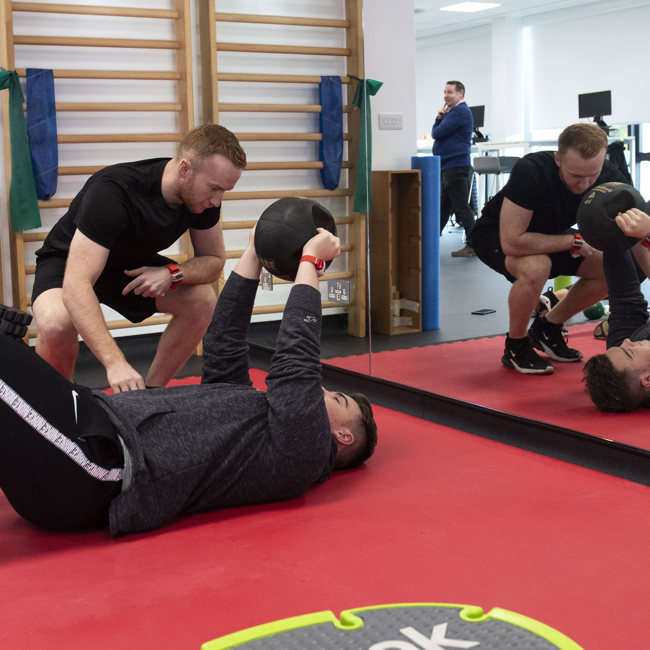
This degree will be taught through a combination of learning methods including tutor-led lectures, tutorials and seminars, practical workshops and exercises in a simulated work environment, small group teaching and group project work. Independent, online and peer-to-peer learning is an important element of this course.
Our BSc (Hons) Sport Development degree uses a variety of assessment methods. The below list provides a guide to the types of assessment methods you can expect:
Programme Specification and Module Descriptors for Undergraduate and Postgraduate courses are available to download (PDFs). These provide you with core information concerning your chosen subject.
Why not add language modules in BSL, French or Spanish to your studies which can count towards your degree or as extra modules? Go on! Broaden your horizons, extend your international perspective and enhance your CV.
Study Modern LanguagesThis programme is in Clearing for students resident in Scotland, Rest of the UK, Republic of Ireland, and EU. During Clearing our entry requirements remain flexible, and we are committed to providing opportunities to study with us based on a range of qualifications. Please get in touch, and we can discuss your specific circumstances. You can apply now through UCAS or find out more information about the Clearing process on our dedicated Clearing hub
We understand that results don’t always go to plan, so our entry requirements during Clearing are flexible. We accept a wide range of qualifications and typically use the UCAS Tariff and the SCQF tariff as a guide, while also taking a holistic approach to each application. This means we’ll consider your overall academic profile and individual circumstances when making decisions.
If you’re close to meeting the entry requirements for your offer or planning to apply through Clearing and looking to top up your qualifications, our Summer School could help you secure your place this September.
If you’re interested, we encourage you to get in touch with our team to discuss your options—we’re here to help.
Visit our dedicated Clearing hub to find out more about the process and next steps.
We welcome Scottish, UK and international students and consider all applicants on an individual basis.
Please visit our Undergraduate Entry Requirements page for information on our different entry requirements, including country-specific details for EU and non-EU qualifications.
BCC (104 UCAS Tariff Points) including a Science (Biology preferred) or PE
H2H2H3H3 including a Science (Biology preferred) or PE
24 points including 3 subjects at H4 including a Science (Biology preferred)
BBB (120 UCAS Tariff points) including Science and PE
Full T Level with Grade M (120 Tariff points) in relevant subject
30 points (136 UCAS Tariff points) with 3 subjects at H4, including PE and English at H4
(HNDs with 3 Graded Units)
SQA HND
Successful applicants who gain a place on this course will need to register on the PVG Scheme, managed and delivered by Disclosure Scotland. An application form will be sent from the University once you have accepted your offer. The fee for joining the scheme is £59.
Visit the Disclosure Scotland website for more information on the PVG scheme.
All academic degrees/awards at UWS are taught in English. For applicants whose first language is not English*, the University sets a minimum English language proficiency level. All English language qualifications must have been gained within two years of the start of your UWS course.
* applicants who are exempt from English language requirements include:
In general terms, if you are applying to study a course at, or above, Year 1 (SCQF Level 7) bachelor’s degree level, then the UKVI’s minimum level of English proficiency is Common European Framework for References of Languages (CEFR) at B2 (Upper Intermediate).
At UWS, we define our general English language requirements using the International English Language Testing System (IELTS) Academic module (not General Training) as follows:
These are minimum requirements and some courses may require a higher standard for admission†.
† Exceptions to this level of IELTS scoring exist for some accredited or professionally-recognised courses (see IELTS Score Exceptions section below for more information).
For our research degrees (MRes, MPhil, PhD, DBA, DProf) applicants are required to have an IELTS score as follows:
For Midwifery courses that lead to professional registration with the Nursing & Midwifery Council (BSc Midwifery), applicants are required to have an IELTS score as follows:
Our BSc Paramedic Science degree leads to professional registration with the Health and Care Professions Council (HCPC); it has different IELTS requirements than other Health-related courses. Although it is not possible to apply for this degree directly as an international student, for applicants who meet SAAS residency requirements and for whom English is not their first language, then the following IELTS scores are required:
For our BSc (Hons) Biomedical Science and MSc Advanced Biomedical Science degrees, which may lead to professional registration with the Health and Care Professions Council (HCPC), applicants are required to have an IELTS score as follows:
Our BA (Hons) Social Work and MSc Social Work degrees are professionally recognised by the Scottish Social Services Council and applicants are required to have an IELTS score as follows:
For our Certificate of Higher Education courses, applicants are required to have an IELTS score as follows:
In additional to IELTS, we also accept a number of alternative English language for application and admission to our courses for both home/EU and international students at bachelor's degree study at Year 3 (SCQF Level 9), and above. From Cambridge to TOFEL iBT qualifications the number of these qualifications is extensive.
Find out about non-IELTS English Language Tests
UWS has also reviewed a range of High / Secondary School qualifications studied by non-EU applicants that can be used as a basis of entry to a UWS. These range from Botswana GCSEs to USA High School Graduation Diplomas, the number of these qualifications is extensive.
Find out more about international English Language high-hchool qualifications
Applicants who do not meet the minimum English language requirements have the option to study one of our preparatory and pre-sessional English courses. UWS courses available are:
£1,820 per year of study (usually paid by the Scottish Government via SAAS*)
£9,535 per year of study (4 years of study for the price of 3 years)
£9,535 per year of study (4 years of study for the price of 3 years)
£18,000 per year of study
£1,820 per year of study (usually paid by the Scottish Government via SAAS*)
£9,790 per year of study (4 years of study for the price of 3 years)
£9,790 per year of study (4 years of study for the price of 3 years)
£18,900 per year of study
Estimated cost per year of study.
Ready to apply? All UK & EU Undergraduate applications should be made through UCAS. Further information for international, part-time and exchange applications can be found below.
Apply through UCASAll UK and EU applicants for undergraduate study, not applying through an agent or partner, should apply through UCAS (Universities and Colleges Admissions Service).
Please refer to our Undergraduate Application Guide for domestic & EU/EEA to find more information on when and how to apply to study at UWS. You can find out more about applying for this undergraduate course on UCAS.
Students from non-EU/non-EEA countries can apply directly to UWS via our dedicated online application system. The latest we can process your application is 6 weeks before the course start date to allow for visa processing times. For more information on when and how to apply to study at UWS please refer to our International Undergraduate Application Guide.
For part-time & online study, you should apply directly to the University through our online application system, not through UCAS. Please select the part-time mode of study when submitting your application. Before you begin your application, it is important to read the part-time application step-by-step guide for a smooth process.
To come to UWS as a visiting student on a study abroad or exchange programme, you must apply entirely through our online system.
An ATAS certificate is not required for overseas students applying for this course.
UK students
Our enquiry team is here to help: ask@uws.ac.uk
International students
Contact our dedicated international team: international@uws.ac.uk
Going to university is about much more than getting a qualification, it’s also the chance to enjoy an exciting social life, gain some independence and make the most of the new opportunities available.
DiscoverWe will always try to make sure that we publish accurate course information but we do not accept responsibility for any mistakes or omissions. We will also try to make sure that we deliver our courses in line with our published information. However, we may not always be able to do so and you can find further information about this in our enrolment terms and conditions.