Recommended Reading and Reviews
Created in 2023, the Vision Schools Scotland Schools’ Library Network aims to encourage school librarians, teachers and pupils to engage with high-quality Holocaust literature, both fiction and non-fiction.
This group comprises teachers and school librarians who are passionate about encouraging reading in general and who are also keen to support wider teaching and learning about and from the Holocaust.
The group has carefully compiled two extensive booklists of Holocaust literature, one for adults, and one for children and young people. The lists have been produced for use by school librarians, teachers, and pupils to be used when selecting texts for study, for personal reading and to help with suggesting what someone could move on to read next.
In curating both lists, the group has been mindful of selecting a range of texts which have both historical authenticity and literary merit. The list for children and young people does not contain specific age appropriateness labelling and therefore educators will need to consider suggestions themselves before presenting them to their learners, either in the context of study in the classroom or for reading for pleasure.
Downloads
Separately, the Holocaust Educational Trust has published a series of very helpful subject guides for both primary and secondary teachers which are free to download from the link below. The primary resource provides guidance around appropriate Holocaust-related content and topics for children of this age. Similarly, the secondary English guide makes useful recommendations for the teaching of texts in the English classroom.
Submit your reviews
Vision Schools Scotland are inviting pupils of all ages, school librarians and both primary and secondary teachers in Scotland to submit their own book reviews and recommendations of Holocaust and post-Holocaust related literature. All submitted reviews will be considered for publication on the Vision Schools Scotland website.
When a review is submitted, the writer’s name will be entered into a draw to win an age-appropriate reading-related prize.
We invite you to submit your reviews to visionschools@uws.ac.uk
Downloads
Pupil Book reviews
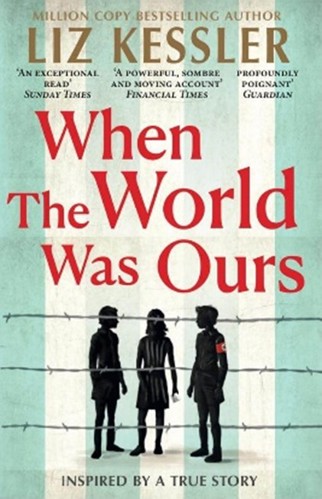
‘When the World Was Ours’, written by Liz Kessler (2021)
 What's the book about?
This young adult novel was inspired by a true story. It focuses on the bond between three young friends and what happens when war and the unimaginable horrors of the Holocaust separate them.
What did you like best?
This is a captivating novel about the Holocaust. It is intriguing to read the different perspectives of three young children put through unfathomable circumstances. This book had me feeling as though I was there, watching these characters, feeling what Max, Elsa and Leo all felt and seeing what they went through, at times all alone.
What, if anything, did you not like?
There was nothing about the book itself that I disliked, however, reading it made me despise those responsible and made me hope for this awful period in history to never to be repeated.
Would you recommend this book?
From what I know, I found the story to be historically accurate and I definitely learned more about what Jewish people went through during the Holocaust. It was an emotional roller-coaster, heart-wrenching but full of hope too. I’m very glad to have read it.
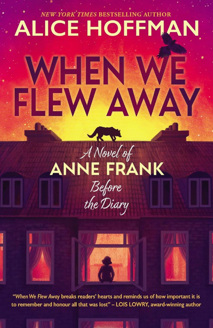
When we flew away: A Novel of Anne Frank Before the Diary’ written by Alice Hoffman (2024)
What is the book about?
This is a fiction book imagining Anne Frank’s life before she started keeping the diary.
What did you like best
I really liked everything because I recently read Anne Frank’s diary so it was interesting to find out more.
What, if anything, did you not like?
One part that made me feel quite sad was when Anne’s grandmother died.
Would you recommend this book?
I would recommend this book to people who liked Anne Frank’s diary or books about the past.
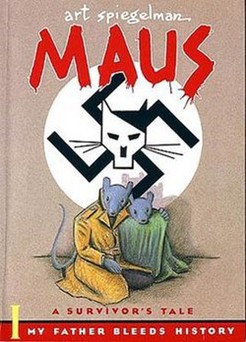
Maus: A Survivor’s Tale by Art Spiegelman (1986)
 What's the book about?
This graphic novel is based on a true story from the author’s father’s life before and during WWII and the Holocaust. In ‘Maus’, all the characters are drawn as animals. The Nazis are cats and the Jews are mice. The book also follows the relationship between the writer, Art, and his father, Vladek Spiegelman. There’s 2 books which make up ‘The Complete Maus’ and this review is of book 1.
What did you like best?
I enjoyed seeing all the characters as animals and the obvious metaphors behind this design choice. I also found seeing how views about Jewish people changed particularly during the war. I found it inspiring to see the manner in which Jewish people in the book came together despite not knowing each other beforehand and before the war.
What, if anything, did you not like?
I didn’t dislike anything about the book itself; however, I did dislike some of the information I learned. For example, about how young children were murdered in Auschwitz for crying. It was shocking to think this happened just to stop a minor inconvenience.
Would you recommend this book?
I would definitely recommend this book – it is an inspiring story filled with different types of conflict. It shows the appalling actions of the Nazis and those who supported and helped them. It also shows the terrible cruelty Jewish people had to face during Hitler’s reign and how life could be very difficult afterwards as a result for survivors. The graphic novel is pitched as an adult one and is recommended for readers over 12.
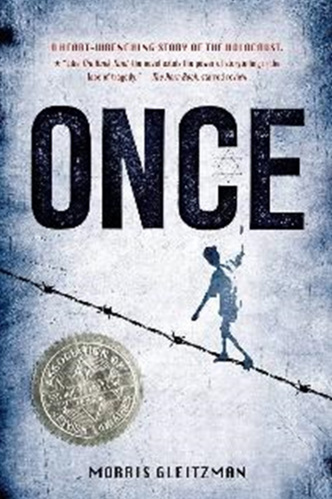
'Once' by Morris Gleitzman, Published August 1st 2005 by Puffin Books.
What is the book about?
Once is about a young Jewish boy called Felix escaping from a Polish orphanage to find his parents during WWII. He is only just starting to understand what is happening around him and in order to survive the Holocaust he uses three key things, bravery, hope, and imagination.
What did you like best?
I liked best that the main characters form a special bond throughout the story. This bond helps them stay positive and hopeful when the war brings bad things towards them. They think of each other as family and protect each other at any time.
What, if anything, did you not like?
The only thing I didn’t like was the amount of detail used in sad scenes. The detail that was used made a clear picture in my head of what was going on, but in some chapters, it was too much.
Would you recommend this book? (Please say why)
Yes, I would recommend this to many people I know. It is a good way to learn about WWII from a child’s perspective. It is very well written, very interesting and it shows that you can always stay positive in a negative situation. Once is both heartwarming and sad at the same time.
Teacher Book reviews
‘Irmina’, written and illustrated by Barbara Yelin
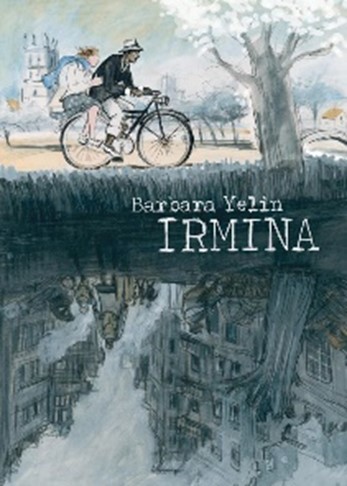 Based on a true story from the author’s own family, albeit a fictionalised account, this graphic novel follows the life of Irmina, a young German woman who moves to London in 1934. There, she falls in love with Howard, one of the first black students to study at the University of Oxford, and she witnesses the casual racism he experiences.
The political upheaval of the 1930s leads to Irmina returning home to Germany. When war breaks out and she cannot leave, we see her views on National Socialism begin to slowly change over time. Almost imperceptibly, she accepts what she perhaps would previously not have and Yelin, visually, tells the story of a normal young woman who becomes a bystander in Nazi Germany because it suits her.
As Irmina’s story unfolds, we see how such a change in a person can occur as well as what the repercussions are, over the course of a long life, of choosing such a way of being. The colour palette used by Yelin to represent Irmina’s life in Nazi Germany is mostly muted and grey, reflecting the shading perhaps of Irmina’s own decision making and moral choices and a life lived which could have been very different.
The author used her grandmother’s diary entries to write ‘Irmina’. It is suitable in terms of its content from S2 onwards, with no graphic images. However, it may not appear to younger readers simply because of its subject matter and the fact Irmina changes so slowly and is a bystander more than a central active character.
It’s most suited to learners with an interest in historical graphic novels and/or educators. ‘Irmina’ can be read without prior background knowledge of Nazi Germany or events and circumstances leading to the Nazis’ rise to power, however, this would add to the reading experience.
The detailed afterword by Dr Alexander Korb, director of the Stanley Burton Centre for Holocaust and Genocide Studies (2012 to 2018), is useful in allowing the reader to further consider the complexity of the story around ideas of complicity and choices.
The Little Liar by Mitch Albom
Set initially in Salonika, Greece, The Little Liar tells the story of Nico Krispis, an eleven-year-old boy whose reputation for honesty leads to devastating consequences when he is manipulated by a Nazi officer during the deportation of the city's Jewish population. Believing he is helping his community, Nico persuades friends and neighbours to board trains bound for Auschwitz. From this moment, Albom traces the intertwined lives of Nico, his brother Sebastian, their friend Fanni and the manipulative antagonist, Udo Graf across decades, exploring the consequences of deception, survival, guilt and forgiveness.
Albom employs an interesting narrative device, with Truth acting as an omniscient narrator. This allows the novel to move beyond a straightforward historical account and instead examine broader questions about human behaviour, morality and the stories people tell themselves in order to live with their choices. Whilst the novel contains moments of hope and compassion, it does not shy away from depicting the devastating impact of the Holocaust on individuals, families and communities.
Particularly valuable is the novel's focus on the Jewish community of Salonika, and Greece more widely, whose experiences may be less familiar to many readers than those of Jewish communities in Central and Eastern Europe. In doing so, The Little Liar broadens readers' understanding of the geographical reach and human impact of Nazi persecution.
The book contains no illustrations or photographs. Instead, Albom relies on vivid characterisation and emotionally resonant storytelling to convey the realities of persecution and loss. Whilst the novel avoids graphic descriptions, the subject matter is challenging and would be most suitable for learners from S3 onwards, particularly those studying the Holocaust, genocide, prejudice or human rights.
The novel can be read without extensive prior knowledge of the Holocaust, although an understanding of Nazi antisemitism and the operation of concentration and extermination camps would enhance the reading experience. It would work well as a supplementary text alongside survivor testimony, the study of Jewish life before the Holocaust, or discussions around bystanders, responsibility and resistance.
Albom's author's note does not include a detailed bibliography or discuss specific research sources. However, he acknowledges organisations such as the The Zekelman Holocaust Centre and Yad Vashem. Whilst the lack of referenced sources may limit its value for those seeking detailed further reading, the novel appears well researched and handles the experiences of Holocaust victims with sensitivity and respect.
The Little Liar is appropriate for student learning and student interest, although teachers may also find it a useful text through which to explore complex ethical questions with young people. Albom's accessible style and compelling narrative make the challenging historical themes approachable without diminishing their significance.
A moving and thought-provoking novel that encourages readers to reflect on truth, responsibility and the lasting consequences of individual choices during one of history's darkest periods.
- Overall Rating: 5/5
- Publisher: Harper Collins
- Publication Date: 2023
- Genre: Historical Fiction
- Ewan Hamilton – Teacher of English
“When I Grow Up – the lost autobiographies of six Yiddish teenagers” written and illustrated by Ken Krimstein
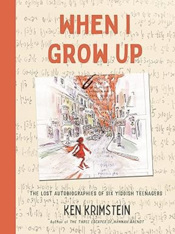
In 2017, hundreds of unpublished autobiographies written by Eastern European Jewish teenagers were discovered in a Lithuanian church cellar. They had been hidden several times between 1939 and 1949, allowing the writing to survive the Holocaust and the tumultuous political years thereafter. The autobiographies had been written as entries to a writing competition launched in 1932 and due to be judged in 1939 by the Yidisher Visnshaftlekher Institut (YIVO). The pieces had long been thought destroyed but were discovered during work on the church in Vilnius in Lithuania in 2017.
This graphic non-fiction book presents six of the autobiographies, each of which is an honest and, at times, humorous snapshot of life for its young Yiddish writer living in 1930s Eastern Europe. A mix in terms of the social class and religious and political beliefs of the anonymous teenage writers, it’s striking how many of the thoughts and feelings seem to sound both contemporary and familiar through their teenage voices. In 1932, the competition organisers had encouraged entrants to write about the seemingly small and mundane experiences in their lives. From exploring romantic feelings to trying to find where you fit into the world, both politically and in a religious sense. From accounts of school experiences, family splits, bereavements and secret ambitions to the struggles (in vain) to emigrate, the graphic novel brings back to life the voices of its writers. The humorous tone helps engage the reader as they listen to how the writers attempted to navigate their way, growing up in a time and place that was becoming ever-increasingly restrictive.
The book could be read without any prior knowledge of the Holocaust. However, having this context would create a deeper comprehension in understanding what was to come and what was to be lost. It is an excellent book through which to hear the mature voices of the six young writers and to gain some form of appreciation of their lives, lives being lived before the Holocaust. As a suggestion, it is most suited to mid-to-older teenagers and adults as an audience, simply because of the concentration levels required for the text and to ‘read’ the images. A lot of the Yiddish words are translated via footnotes and the background to the discovery of the writing is also explained. Ken Krimstein also provides a list of sources and suggested further reading.
Published by Bloomsbury, 2021
Last updated: 03/09/2025